
Golden Retriever
Water-repellent double coat selected for cold-water waterfowl retrieval, requiring systematic undercoat raking and strict ear-canal moisture control.Canis lupus familiaris
The Golden Retriever is a large (25–45 kg) breed, originating in United Kingdom, standing Males 58-61 cm (23-24 in); females 55-57 cm (21.5-22.5 in), weighing Males 29-34 kg (65-75 lb); females 25-29 kg (55-65 lb), with a double coat coat, and a lifespan of 10-12 years. Reviewed against institutional breed standards and veterinary dermatology benchmarks by the PGA Editorial Board.
- Origin
- United Kingdom
- Mass Range
- Males 29-34 kg (65-75 lb); females 25-29 kg (55-65 lb)
- Height Range
- Males 58-61 cm (23-24 in); females 55-57 cm (21.5-22.5 in)
- Longevity
- 10-12 years
- Coat
- Double Coat
- Size Tier
- Large (25–45 kg)
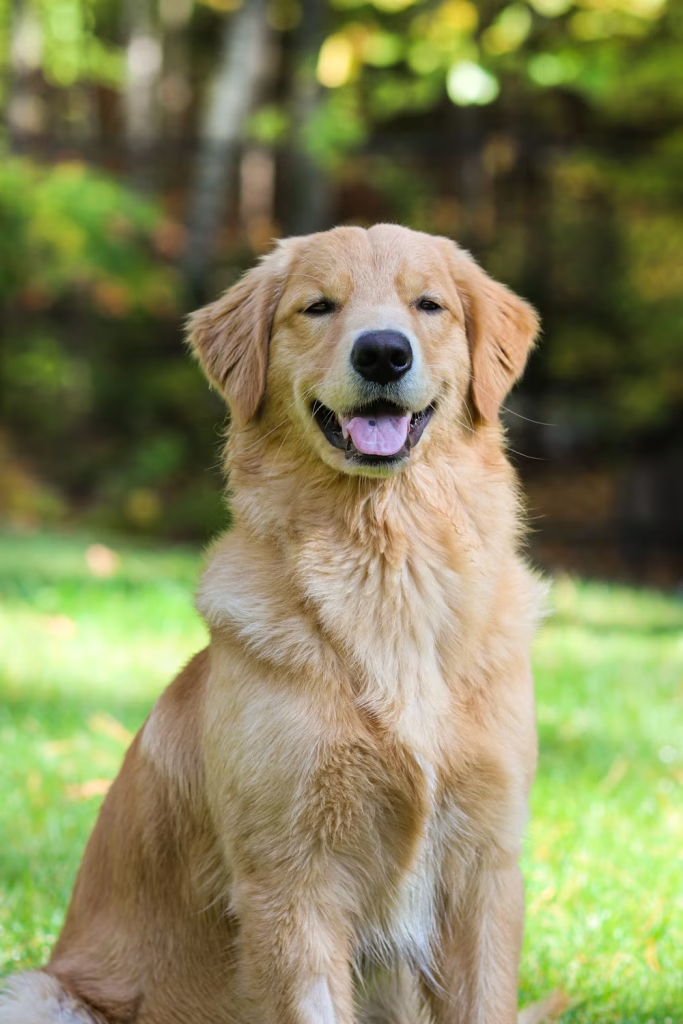
Dudley Marjoribanks developed the Golden Retriever at Guisachan in the Scottish Highlands beginning in 1868 to retrieve waterfowl across cold lochs and rough moorland. A dense, lanolin-rich undercoat beneath water-shedding guard hairs insulates the skin during immersion. Weekly undercoat raking prevents matting behind the ears, elbows, and hocks while preserving natural coat structure.
Quantitative Behavioural & Care Telemetry
Indexed scores derived from breed-standard descriptors. Each gauge carries its numeric value and qualitative band for direct comparison.
Ancestral Sequence & Genome Reconstruction
Registry formation is a recent overlay on older landrace ancestry. The summary below states the founder interpretation; the full reconstruction is published as a separate monograph.
Heritage & Evolutionary Lineage
The Golden Retriever lineage is documented from archaeozoological, genomic, and registry records, distinguishing older landrace origins from modern standardisation.
- Origin Country
- United Kingdom
- Specific Region
- Scottish Highlands (Guisachan, Inverness-shire)
- Registry Overlay Period
- 1913
- Pre-Registry Utility
- Waterfowl and upland game retrieval
- Current Function
- Companion, field trial retriever, guide and assistance dog, search and rescue
- Registry Classification
- Sporting
- International Group
- Group 8, Section 1
- Registry Status
- AKC Recognized
No pre-standardisation landrace existed before Dudley Marjoribanks opened his 1868 Guisachan breeding ledger in Inverness-shire, crossing yellow wavy-coated retriever Nous with Tweed Water Spaniel Belle. The Kennel Club registered the variety in 1913, and the American Kennel Club followed in 1925.
Physical Phenotype Specification
Biometric traits and coat architecture compiled from institutional breed standards. Compound ranges are declared as structured min/max values in the page graph.
- Size Tier
- Large (25–45 kg)
- Weight Range
- Males 29-34 kg (65-75 lb); females 25-29 kg (55-65 lb)
- Height Range
- Males 58-61 cm (23-24 in); females 55-57 cm (21.5-22.5 in)
- Lifespan Expectancy
- 10-12 years
- Coat Architecture
- Double Coat
- Coat Length
- Medium (1–3 in)
- Accepted Colors
- Rich, lustrous golden of various shades, from light cream to dark golden
- Temperament
- Biddable, socially confident, and cooperative with high human-directed attentiveness and strong oral-retrieval drive; requires structured daily physical and cognitive work to prevent mouthing or leash pulling.
Environmental & Household Compatibility
Household dynamics, multi-species tolerance, and spatial adaptability. Ratings describe breed-level tendencies, not individual guarantees.
- Children Compatibility
- Yes
- Canine Compatibility
- Yes
- Feline Compatibility
- Yes
- Apartment Suitability
- With Adequate Exercise
- Thermal Tolerance
- Temperate to cold climates; dense undercoat insulates against cold water, while high ambient heat requires shade, hydration, and post-swim drying
- Vocalization
- Quiet
- Spatial Requirements
- Suburban or rural home with secure fenced yard preferred; adaptable to apartments when provided structured daily outdoor exercise and swimming access.
Grooming Protocol & Tool Geometry
Maintenance intervals, surfactant chemistry boundaries, and the precise tool geometry required to preserve coat integrity and skin health.
- Brushing Interval
- Rake and brush to skin 3-4 times weekly; daily during spring and autumn blowout
- Bathing Interval
- Every 4-6 weeks with thorough conditioning and high-velocity drying to skin
- Salon Maintenance
- Every 6-8 weeks for undercoat deshedding, sanitary tidy, paw pad clearing, and ear hygiene
- Thermal Boundary
- Force-dry with cool-to-warm airflow not exceeding 38 C (100 F) at a minimum 15 cm standoff distance. Never shave.
Health, Dermatological & Clinical Risk
Documented genetic conditions, dermatological vulnerabilities, and preventive screening protocols compiled for veterinary review.
Common Conditions
- Hemangiosarcoma
- Lymphoma
- Hip and elbow dysplasia
- Cranial cruciate ligament rupture
- Subvalvular aortic stenosis
- Progressive retinal atrophy (GR-PRA1, GR-PRA2)
- Neuronal ceroid lipofuscinosis (NCL5)
- Hypothyroidism
Recommended Screenings
- OFA or PennHIP Hip Evaluation (US) / BVA-KC Hip Scheme (UK)
- OFA Elbow Evaluation (US) / BVA-KC Elbow Scheme (UK)
- CAER Eye Examination (US) / BVA-KC Eye Scheme (UK)
- OFA Advanced Cardiac Exam (auscultation and echocardiography)
- DNA panel: PNPLA1 (ICT-A), GR-PRA1, GR-PRA2, NCL5
Cancer accounted for 65.0% of deaths in a 652-dog Golden Retriever necropsy cohort, led by hemangiosarcoma (22.64%) and lymphoid neoplasia (18.40%) (Kent et al. 2018). Maintain lean body condition, dry pendulous ears after swimming, and complete annual cardiac, ophthalmic, and orthopedic screening.
Reference navigation
Further monographs and the species index. Every destination carries its own editorial review state.
